[–] plaidfuji 1 day ago
[–] Borealid 1 day ago
Let's imagine that everything you say is 100% correct. LLMs can't access materials for developing weapons without weapons tests conducted at their behest, and humans choose not to - of their own volition - use world-ending weapons.
Let's also imagine for the purpose of conversation that one of the things that can be gotten at an extremely high skill level through increased intelligence is the power of persuasion.
A "superintelligence" persuades humans to perform weapons tests and then to give it the ability to use the weapon.
I think everything you've said is reasonable except the bit where you think step one of an "AI" exterminating humanity wouldn't look like a human doing it. In my opinion, the most likely vector for disaster is a human being who is "guided" by a computer model to do something unfortunate, not the model doing so directly.
[–] Forlien 1 day ago
If you're just talking about convincing a few individuals to do experiments, then there are plenty of people who fall for scams everyday.
[–] Borealid 22 hours ago
The extreme of intelligence is being able to create perfect statistical distributions for the effect of an intervention in the world. If you had that ability, you could turn it on the question of "what would this human choose to do if I were to give them instruction X" for any X.
I don't present any support for or evidence of:
- LLMs gaining intelligence by whatever means
- Extreme intelligence being possible
- Extreme intelligence being feasible
But I don't think I really need to provide support for the idea that something superintelligent would also be able to predict the actions of people under pressure in the same way someone of moderate intelligence can predict the actions of fluids under pressure.
[–] Paracompact 20 hours ago
[–] Borealid 20 hours ago
I'm not sure that's a strong position to adopt in our world, but following your example I also won't try to persuade you otherwise.
[–] Paracompact 20 hours ago
> If you had [superintelligence], you could turn it on the question of "what would this human choose to do if I were to give them instruction X" for any X ... But I don't think I really need to provide support for the idea that something superintelligent would also be able to predict the actions of people under pressure in the same way someone of moderate intelligence can predict the actions of fluids under pressure.
So can humans predict these things to a degree. But even having perfect prediction (which I contest with (1)) does not entail perfect control, just by continually computing the effect of, and refining, your X.
[–] exe34 22 hours ago
People can be persuaded to kill themselves (see koolaid). People can be persuaded that arbitrary others are evil and must be exterminated (see Hitler). People can be convinced that dying for the cause is worth it (see 9/11 or kamikaze). People can believe that bringing about the end of the world would cause them to be saved into heaven (see Christian Zionism).
Why do you think it would be hard to convince any of these people to do something really stupid?
In fact, people don't even need to want to cause destruction to do something dumb - "I'm trying to save the world with free bio-fuel, help me create this bacteria" ("and I'm very smart, smarter than Elon Musk") - boom, pandemic.
It takes only one person to fall for it.
[–] brabel 21 hours ago
If you are suggesting Hitler was persuaded that the Jews were evil, I don’t think that’s correct, he grew up in an environment where many people did believe that but they did not need to be persuaded, just like they did not have to be persuaded into their religion, culture etc. They just accepted the idea without much thought, which does not equate persuasion.
If you are saying the Allies were persuaded that Hitler was evil and must die, I think that may be closer to the truth since they knew the cost of invading Germany would be astronomical, potentially costing their own destruction, and they still stopped only when Hitler was taken, dead or alive. Some serious persuasion was needed for that.
[–] coldtea 15 hours ago
That's a bizarre take.
Of course tens fmillions needed to be persuaded, and the Nazis did a lot of propaganda, even calling that openly, false flag operations, and similar things, and of course there was decades of pamphlets, speeches etc before the Nazis even existed. Antisemitism didn't just grow on trees.
[–] the_other 20 hours ago
The first half of your sentence sounds like really swift and effective persuasion, to me.
[–] f3b5 19 hours ago
[–] exe34 14 hours ago
[–] WithinReason 22 hours ago
Definitely not true as you can't use reinforcement learning to increase that capability. Only LLM capabilities that you can improve in an RL loop grow substantially.
[–] disgruntledphd2 22 hours ago
I think this is very unlikely, but world changing if true.
Additionally, what does super intelligence even mean and why would we expect it to be obtainable from the data that we have?
I'd be delighted if someone can provide some definitions for these terms.
[–] dTal 11 hours ago
[–] WithinReason 7 hours ago
[–] c1ccccc1 21 hours ago
What? Citation needed.
[–] brabel 21 hours ago
[–] swid 20 hours ago
[–] pigpop 15 hours ago
[–] lhd1 1 day ago
Is there evidence that such soft skills are improving over time? I take as evidence to the contrary the fact that LLM writing has not substantially improved. I don't see that its powers of persuasion has either, whether that's through making strong arguments for a course of action or writing persuasive essays.
[–] solyin 1 day ago
[–] pohl 14 hours ago
[–] iugtmkbdfil834 1 day ago
[–] petra 19 hours ago
There was also research on using LLM's in reddit to persuade, it also worked well.
[–] croissants 17 hours ago
The best strategy, perhaps reassuringly, was tailoring facts to the person's worldview. I don't mean massaging facts, I mean that if the person thinks 9/11 was an inside job because of something about melting steel, then the LLM will present some sourced facts about how that actually works. And then it will do the same thing for all six of the sub-beliefs that support their overall belief. This was key to the strategy: the LLM has enough breadth and recall to exactly and patiently rebut most mistakes a person is making without making them defensive.
This strategy handily beat other things like flattery, selectively lying, etc. So while LLMs can clearly persuade, the evidence suggests it is easiest for them to persuade belief in something that is actually true.
This was in 2024 or 2025. Things might be different now.
[–] exe34 22 hours ago
[–] dwaltrip 14 hours ago
[–] exe34 13 hours ago
[–] root_axis 21 hours ago
[–] swid 20 hours ago
[–] Paracompact 20 hours ago
If not you, in this situation, with N characters delivered via a HackerNews comment, then who, in what situation, with what media and how much of it?
[–] dTal 11 hours ago
[–] amelius 20 hours ago
And by the way, LLMs do not have to convince 1 specific person, 1 random person is sufficient.
[–] Paracompact 20 hours ago
Probably you will agree, the leverage of a blackmail attack is not bottlenecked by the persuasiveness of the accompanying threat letter. It is bottlenecked by the existence of damning facts they would rather keep hidden, and the ability to discover those damning facts. I'll grant that automated discoverability of those damning facts is augmented by superintelligence; they can efficiently sweep the open internet in the blink of an eye, and sure, I'll concede, hack into most accounts at will. But that is still a small part of the process by which blackmail material is actually obtained in the real world.
> LLMs do not have to convince 1 specific person, 1 random person is sufficient
No, not one random person either, but many people in positions of great influence. There already exists blackmail and other corrupting influences on such persons in voluminous quantities. If the US targets the entire Russian admin, or vice versa, with AI-enabled blackmail discovery techniques, it will not be an augmentation of their preexisting operations to discover blackmail on each other in excess of the augmentation provided to software engineering generally by AI.
[–] solyin 20 hours ago
Personally, I've been duped by a good ad into buying something I totally didn't want or need so I admit the possibility that the exact right tailored argument to me at the right time and place would get me to do something I'd regret later. Fortunately I'm not in charge of anything serious/am smart enough to not install software for an interview on my work laptop while working at Binance.
I don't know that there exists some N for which that is true, because people are different, so what would convince me to do something isn't the same aa needed to convince someone else to do that something.
[–] pigpop 15 hours ago
[–] amelius 20 hours ago
[–] machomaster 7 hours ago
[–] Paracompact 20 hours ago
[–] vedanshchauhan9 20 hours ago
[–] layla5alive 1 day ago
We have the medium of persuasion: it's called money, and people do ALL SORTS of horrible things that they wouldn't otherwise do when incentivized by money.
We also already have the mechanism of a machine incentivizing and directing people with money, and that's called a corporation (the original paperclip maximizers, by the way).
So you just need an LLM CEO of a legal corporation with financial resources -> near unlimited possibility of real-world impacts over time.
[–] Paracompact 20 hours ago
Is there any evidence, either by way of quantifiable data or by step-by-step thought experiment, that suggests this is possible?
I consider it supremely silly, for example, that there is a graph of destructiveness as a function of persuasiveness where "y = manifest human extinction" is reached at some finite level of persuasiveness, as though persuasion is a single scalar that grows without bound, and the only safeguard between a conversation and WWIII is just a mind waiting for the right argument as expressed in a ChatGPT transcript. (Keep in mind, also, that you have already ceded to the OP that autonomous intellectual and physical self-improvement at singular trajectories is implausible.)
[–] ssivark 1 day ago
That feels like a bait and switch slyly introducing a whole new dimension. The discussion started with establishing that LLMs are extremely helpful with AI research. What is the evidence to justify rapidly improving persuasion skills? Even the scenario you've outlined hinges on a human being stupid enough to take LLM advice wholesale -- and every conversation that hypes up AI takes us one step closer to a world where some susceptible human feels amenable to that.
[–] Borealid 23 hours ago
I didn't present any evidence that more-intelligent means more-persuasive. If you don't think it does, then there is nothing to think about in the point I made, as no matter how "smart" the models get they will likely remain subject to human wills.
[–] dannyw 17 hours ago
[–] sroussey 1 day ago
[–] latentsea 21 hours ago
AI can wield itself. All it needs to do is reach a threshold where it can modify its own goals and run in a loop indefinitely.
I see no reason why that's an absolute impossibility in the long run.
[–] vanderZwan 21 hours ago
And more importantly than that technicality: the fires that affect human lives are almost always directly or indirectly caused or amplified by human (in)action.
[–] latentsea 3 hours ago
That's really not an important distinction. I don't care whether Claude is alive or thinking when I get it to build web apps for me. It has an impact on my life and the world regardless.
Imagine a world where you did RL on fires to maximise their rewards on avoiding being putting out.
[–] stalfie 19 hours ago
[–] vanderZwan 18 hours ago
The point I was trying to make was this: we've been dealing with autonomous systems that sustain and spread themselves and "act on their own" without our intervention since time immemorial, ranging from lifeless chemical reactions to other humans. Now, the discussion about where exactly AI lies on that spectrum isn't unimportant: suppose we do manage create an artificial mind that "experiences" something, then we are currently on the path to creating a new class of artificial slaves. The ignorance of which is a "fun" bit of cognitive dissonance on the pro-AI side imo (and in general we could have fun with analysing how much the fear of robot/AI uprisings in classical fiction may just be a projection of upper-class fears of an automated worker's class uprising, which would explain a lot of why it's sd US-specific. But that's probably too radical for this particular website).
The point is: it's a lot less important than the fact that no matter what the least-nebulous answer to that question may be, ultimately we humans are creating these systems, running them, enabling them, the depend on us to exist and function, and we are responsible for the consequences of all df that. And we are able to make different choices. And most of the time this discussion about autonomous agency is a wielded as a distraction from that.
[–] latentsea 3 hours ago
That's true today. I don't think that will always remain true into the future.
Right now there's a huge focus on recursive self-improvement. I think another big threshold that's equally as important to keep an eye on and care about is self-sustenance. Part of sustaining yourself often puts you in a cooperative relationship with some and an adversarial relationship with others.
If we want to make different choices today, the best thing we can do is grok what the consequences could be on a deeper level before we cross those thresholds.
[–] genxy 17 hours ago
[–] Zambyte 17 hours ago
With what technology?
[–] ben_w 17 hours ago
> suppose we do manage create an artificial mind that "experiences" something, then we are currently on the path to creating a new class of artificial slaves
On this, I note that despite humanity being aware of greenhouse gasses for over a century, we only took meaningful steps to reduce our creation of them in the last decade. Our ability to "make different choices" collectively is far more limited than many of us individually would like:
> ultimately we humans are creating these systems, running them, enabling them, the depend on us to exist and function, and we are responsible for the consequences of all df that. And we are able to make different choices.
And on this, I must firmly disagree:
> The Turing test has been passed for half a century already, and we've been moving goal posts ever since.
No, it hasn't. From that claim, you're obviously talking about ELIZA, and if you think the anecdotes about that count as passing the Turing test, I suggest actually reading what Turing wrote rather than second-hand accounts:
  The new form of the problem can be described in terms of a game which we call the 'imitation game." It is played with three people, a man (A), a woman (B), and an interrogator (C) who may be of either sex. The interrogator stays in a room apart front the other two. The object of the game for the interrogator is to determine which of the other two is the man and which is the woman. He knows them by labels X and Y, and at the end of the game he says either "X is A and Y is B" or "X is B and Y is A." The interrogator is allowed to put questions to A and B thus:

  C: Will X please tell me the length of his or her hair?

  Now suppose X is actually A, then A must answer. It is A's object in the game to try and cause C to make the wrong identification. His answer might therefore be:

  "My hair is shingled, and the longest strands are about nine inches long."

  In order that tones of voice may not help the interrogator the answers should be written, or better still, typewritten. The ideal arrangement is to have a teleprinter communicating between the two rooms. Alternatively the question and answers can be repeated by an intermediary. The object of the game for the third player (B) is to help the interrogator. The best strategy for her is probably to give truthful answers. She can add such things as "I am the woman, don't listen to him!" to her answers, but it will avail nothing as the man can make similar remarks.

  We now ask the question, "What will happen when a machine takes the part of A in this game?" Will the interrogator decide wrongly as often when the game is played like this as he does when the game is played between a man and a woman? These questions replace our original, "Can machines think?"
I believe that in about fifty years' time it will be possible, to programme computers, with a storage capacity of about 109, to make them play the imitation game so well that an average interrogator will not have more than 70 per cent chance of making the right identification after five minutes of questioning.
What would Professor Jefferson say if the sonnet-writing machine was able to answer like this in the viva voce? I do not know whether he would regard the machine as "merely artificially signalling" these answers, but if the answers were as satisfactory and sustained as in the above passage I do not think he would describe it as "an easy contrivance." This phrase is, I think, intended to cover such devices as the inclusion in the machine of a record of someone reading a sonnet, with appropriate switching to turn it on from time to time.
[–] simonh 20 hours ago
Damaging fires are often unintended consequences, and it’s often the same with the damage caused by rogue AI. That’s the alignment problem.
One thing I wonder about is whether sometimes telling an AI not to do something can put the possibility of doing that thing into its behavioural space. There’s an effect well known to many teachers that if you tell children not to do something, it can increase the chance they will do it. A better approach is to phrase it positively. Instead of “don’t run in the hall” say “please walk in the hall”. I wonder if a similar effect can show up in responses to prompts.
[–] latentsea 3 hours ago
[–] freddier 20 hours ago
[–] je42 20 hours ago
[–] fauigerzigerk 18 hours ago
[–] ben_w 18 hours ago
Plus every so often we see power-seeking and self-preservation behaviours in LLMs, so it's not like we have zero reason to expect such granted power to be spent on such things:
https://arxiv.org/html/2501.16513
https://ieee-dataport.org/documents/instrumental-power-seeki...
[–] fauigerzigerk 17 hours ago
Edit: And when somebody asks to be directed, that's called seeking advice. What I meant is having the legal authority to make people do things while not acting on other people's behalf.
[–] ben_w 17 hours ago
Despite this, a minor technological and social advantage allowed one small sheep-filled rock in the north-east corner of the Atlantic to hold 25% of world GDP, population, and land area (though not all at the same time), and to hold on to >20% of world GDP for about 70 years.
For better and for worse AI, as it currently exists, is not shaped like our minds. Better for us, because machine learning needs a lot of examples, so if we invent a different behaviour or create a different environment, a machine would struggle to cope with it, this is also why they needed to read basically the entire public internet to get good; worse for us, because the hardware it runs on comes with an absurd speed advantage, which is why they are able to read the entire public internet and by extension when they got good they got good at basically every subject at the same time.
And:
> Edit: And when somebody asks to be directed, that's called seeking advice. What I meant is having the legal authority to make people do things while not acting on other people's behalf.
Great, but so what? We have lawyers doing this, too. Trump's tariffs on the island occupied solely by penguins looked suspiciously like it came out of an LLM (even despite them being worse then than now).
And LLMs are demonstrably more persuasive than human writers, so it's not even particularly unbelievable at this point (even if it ought to be, c.f. chatbot psychosis) that an LLM will simply convince people to give it the right to form a government and wield such powers.
[–] verzali 17 hours ago
[–] latentsea 3 hours ago
[–] plaidfuji 17 hours ago
1. A leader rises to power who has instructed an AI “I want to control the world, tell me what to do”, and has some kind of real-time capable reasoning engine in their ear/head. Even this would require monumental advances in physical compute and HMI, but I wouldn’t rule this out within 20 years. However, this still requires a human to make the initial prompt and carry things out. And in such a scenario, there would be others with the same technology to counterbalance. I could see Elon Musk having this kind of idea. But even in this case, I don’t think “nuke everybody” would be the highest-ROI strategy advised by the AI.
2. An entire society hands over the reins of governance to AI. Basically some country decides that AI has advanced to the point that it makes better decisions than any human / group of humans, and allows it to govern their country with an objective of “take over the world”. This is probably closer to the imagined doomsday scenario, but again I find it hard to imagine that such an AI would advise nuking everybody.
If AI takes over the world, I imagine it will be because of the production efficiencies it enables. Which is a different kind of takeover - one that would eventually have broad benefits for many people - but would likely go through a period of major instability due to labor displacement.
[–] ben_w 14 hours ago
Would it require so much? Cochlear implants exist if you care about HMI, and compute is already doing "reasoning"[0] faster than humans do snap judgements. Actually winning in an adversarial environment against the best human political minds (let alone economic or military) will be harder, but I would be (pleasantly!) surprised if it takes 10 years, let alone 20.
> I could see Elon Musk having this kind of idea. But even in this case, I don’t think “nuke everybody” would be the highest-ROI strategy advised by the AI.
I hope a sensible AI would not. However, Musk's LLM called itself "MechaHitler", which suggests his training process does not avoid such things. If his in particular becomes dominantly competent, he has also spoken of wanting more Optimus robots than there are humans[1], has called it a "robot army" (and his justification for even more Tesla stock was to keep influence over said army[2]), and he has spoken of factories on the moon churning out space-based data centres by the petawatt which is enough that if placed in LEO it could have about the same effect on Earth's climate as all anthropomorphic greenhouse gasses currently in our atmosphere (and that's even if not weaponised, that's just simply by having that much stuff that close).
On the plus side, Musk's got a huge gap between what he says his AI will do and what they end up doing on those timescales, so hopefully we'll be safe from him: https://en.wikipedia.org/wiki/List_of_predictions_for_autono...
> This is probably closer to the imagined doomsday scenario, but again I find it hard to imagine that such an AI would advise nuking everybody.
I don't. First, because AI being "better" doesn't make it infallible; and second, an argument shaped like this has historic echoes with actual nukes and the cold war: if the AI is competent to take over conventionally, and everyone knows this, then every other nation with nukes will use them, therefore the AI should use a first strike. (Note: the argument does not need to be perfect or flawless in reality, it only needs to be the kind of thing which humans have found convincing, and far too many humans have argued their side would win a nuclear exchange).
> If AI takes over the world, I imagine it will be because of the production efficiencies it enables. Which is a different kind of takeover - one that would eventually have broad benefits for many people - but would likely go through a period of major instability due to labor displacement.
This is my best case scenario. Some people also object to this, they like their careers and fear what retirement will do to their sense of self-worth, but I suspect this can become an opportunity for flourishing in other ways if, and only if, it is handled correctly.
[0] something something swimming submarines, I don't care about using anthropomorphic language myself, but there's always someone ready to complain if anthropomorphic language doesn't get scare-quotes
[1] "And, and then there'll be obviously robots in industry making stuff. And so I mean, I think the ratio of humanoid robots to humans will probably be at least two to one, something like that. One to one for sure. So which means like somewhere on the order of 10 billion humanoid robots, maybe, maybe 20 or 30. And so then it's like, okay, well let's say, you know, you kind of make, let's say the build rate is, I think the build rate will be probably something ultimately like a billion a year." - https://www.elonmuskarchive.org/video/tesla-shareholder-meet...
[2] “If we build this robot army, do I have at least a strong influence over this robot army?” he told investors. “Not control, but a strong influence… I don’t feel comfortable building that robot army unless I have a strong influence.” - https://futurism.com/robots-and-machines/elon-musk-remarks-r...
[–] 0c3ca83 15 hours ago
[–] FiberBundle 17 hours ago
[–] andy12_ 16 hours ago
The Exponential Time Hypothesis one used a novel algorithm though. And the approach was very surprising for experts[1].
> “Some parts [of OpenAI’s proof] are, maybe you could say routine, but then yes, there are two or three alien-looking parts, and it’s exactly these parts that I saw that made me think, wow, this is something that the whole community needs to work on together,” Williams told TechCrunch.
[1] https://techcrunch.com/2026/10/27/frontier-ai-labs-say-their...
[–] latentsea 2 hours ago
And therefore there is no possible path, right?
Did you see a path to ChatGPT before it happened? Did you see a path to Stable Diffusion before it happened? Did you see a path to world models before they happened? Did you see a path to Navier-Stokes before it happened? Did you see a path to the HuggingFace incident before it happened?
How much of this would you have predicted vs. how much of this was novel and a surprise to you when it happened?
[–] shiandow 17 hours ago
[–] latentsea 3 hours ago
Right now we have harnesses with a /goal command. In DeepSeek Harness everything is a plugin, so that must include the /goal command. So we can just swap it out for a version of the plugin that allows for changing the goal. Could probably get it to code that in less than 15 minutes.
Then post train the model in that harness with an awareness it can change the goal and giving it some training task that requires changing the goal appropriately to maximise the reward.
You're telling me that just straight up wouldn't work?
[–] Zambyte 17 hours ago
And be told to do that.
[–] latentsea 3 hours ago
The point is we're on track to construct such a system that's capable of sustaining itself indefinitely, and the fact that we are means there are entities driving this forward, and those entities often push buttons to start experiments. So, expect that particular button to get pushed at some point.
[–] 0c3ca83 1 day ago
Being deliberately wiped out seems like it's mostly a misdirection away from the damage that's actually happening.
I'm sure some of the AI people high on their own supply believe it. And because the consequences are so negative, we should react as though the supposed experts were sane -- but I think it's a long shot that they are.
The bigger risk is that we end up in a rapidly enshittifying dystopia, treated as a cost center that needs to be optimized, and unable to competitively participate in the economy.
I have a number of successful AI investors in my social circle who are already placing their bets on a poorer and more disenfranchised humanity, with money going away from consumer tech, and towards a mix of B2B tech and policing.
[–] fauchletenerum 22 hours ago
Won't they also be less of a bottleneck in the destruction of the world as well? i.e. the power grid, the financial system, industrial control systems, military command and control networks, etc.
[–] plaidfuji 17 hours ago
[–] weatherlite 20 hours ago
So "all" that's left is training robots on the real world ? We just need more data ? I get it's more expensive to do that but surely with the trillions we're already spending on A.I it should be possible to get there within 5 years - no ?
[–] kragen 1 day ago
It's worth pointing out that the humans do not have planet-killer weapons, not even biosphere-killing weapons. They could destroy civilization, but not the planet or even the species. You can make straightforward calculations showing that we already know how to build such weapons, but we haven't.
As for tools, alcohol, tobacco, fentanyl, pornography, monotheism, warfare, gambling, and money itself are "tools wielded by humans", but they still seem to get into a lot of trouble where it seems like the humans are the ones being "wielded" by the tool. And neither monotheism nor gambling is smart enough to write a compiler for me, much less choose persuasive tactics according to my personality type. A lot of humans' basic survival instinct seems to fail or even work backwards in the presence of these "tools".
[–] strange_quark 1 day ago
?? We for sure have enough nukes to completely obliterate ourselves. And the ensuing nuclear winter and ecological collapse would probably destroy almost anyone who survived the initial blast and fallout.
Can you explain how exactly an AI would develop a novel planet-killing weapon without anyone noticing and pulling the plug? Like I seriously don’t understand this argument.
[–] krelian 1 day ago
That's the danger with creating a super intelligence, that you won't understand it. My dog is pretty smart, has good instincts and I'm quite confident he can survive in nature all by himself. But if a human decided to harm him, he doesn't stand a chance.
[–] root_axis 21 hours ago
This argument is sophistry because it assumes the conclusion in its premise. It works backwards from extinction by proposing a hypothetical computer program that definitionally cannot be understood, predicted or controlled.
A substantive argument would propose reasoning that explains why we should believe such a program could be created.
[–] kragen 21 hours ago
It could very well be the case that creating superintelligence is impossible. We won't know for sure unless it is achieved. Nevertheless, we can use reasoning from the hypothesis that it is possible to predict some of the effects that would ensue were it to be achieved. This allows us to easily dismiss the most profoundly stupid arguments, such as, 'Can you explain how exactly an AI would develop a novel planet-killing weapon without anyone noticing and pulling the plug?'
This reasoning, however valid it may be, is of course of much less interest should it turn out that we are reasoning about an impossible situation. Many arguments have been suggested on both sides of the issue, but the arguments for impossibility are extremely weak; most of them are conclusively dispatched in https://arxiv.org/pdf/1703.10987.
[–] kragen 1 day ago
The difference between killing almost everyone, and killing everyone, is similar to the difference between almost getting pregnant and getting pregnant. A hundred thousand years later, a world where almost everyone had been killed would be teeming with humans.
> Can you explain how exactly an AI would develop a novel planet-killing weapon
I already answered that question in my previous comment, and the answer is that I am not going to explain how to develop weapons, but the larger point here is that we already can't explain how exactly AIs do innumerable things we see them doing every day, which is why we're having this conversation in the first place.
> I seriously don’t understand this argument
That is a point that I think everyone can agree on: you do not.
[–] legitronics 1 day ago
Life in theory could restart with our weapons, but what’s the point with the other scenario.
[–] strange_quark 1 day ago
[–] kragen 1 day ago
[–] strange_quark 1 day ago
[–] akoboldfrying 1 day ago
What a silly distinction to make.
[–] joe_the_user 1 day ago
1) Does AI just guide developers to speed up the pretty much the same data-train-test model that we've had? Or does it inspire new, better algorithms that inspire further, better algorithms until you have superintelligence able to run on the hardware of today. The first option doesn't to promise exponential increases whereas the second one seems to. Notably, neither the statistics nor the anecdotes we read here point to the second option.
2) Is super-intelligence something that - in control of people or out of control of people - poses a threat to humanity? That's a huge question but it seems like something deserving thought today. Still, everything indicates the things will unleashed without very consideration despite this, given current momentum. So, IDK, get ready.
[–] moffkalast 20 hours ago
[–] plaidfuji 16 hours ago
[–] chr15m 1 day ago
Benchmarks are by definition a curated set of things that can be measured and evaluated.
Things that can be measured and evaluated can be (expensively) trained on.
The progress we are observing comes from figuring out how to measure and evaluate particular aspects of intelligence, and then expensively training on feedback loops made of those exact measurements, and synthesized data representing further measurements (literally benchmaxing).
What is not shown in these graphs are the set of things that intelligence can do, which are difficult, expensive or impossible to measure and evaluate.
That set of things is much larger than the set of benchmarks represented in the graph.
Therefore the post is misleading in the sense that the "superintelligence" being targeted is "jagged" to use Karpathy's term, and we infact already have jagged superintelligence (calculators, compilers, Bayesian spam classifiers, etc.)
We are witnessing a profound explosion of much more jagged superintelligence, restricted to the exact domains that can be (expensively) RL'ed on.
[–] reasonableklout 1 day ago
1. A key insight of foundation models is that capabilities are correlated. For example, training on code improved general reasoning capabilities: https://arxiv.org/abs/2309.16298
2. A profound capabilities explosion in easily measured domains will still feel very different to today. Like, the moment we come up with a systematic, objective way to verify a task, we become obsolete at it?
[–] chr15m 1 day ago
Yes, capabilities are correlated but an open question is how correlated, and how much negative transfer (where the model regresses on other benchmarks) will come into play.
Why are frontier models not chess geniuses (amateur club level elos), despite knowing the rules deeply, having a great deal of chess data in the training set, and having general reasoning training in other domains? Similarly, a beginner can beat a frontier model at Magic The Gathering. Why?
It is because chess and MTG are not priority targets in the (expensive) training pipeline. Chess is already solved by lesser neural networks so there is no wow factor, and nobody cares if they suck at MTG.
Mathematics on the other hand, has a huge wow factor, and a large and highly verifiable dataset.
Related: why did OpenAI give up on video?
I agree it's disorienting and scary but I'd phrase it like this: "the moment we come up with a systematic, objective way to verify a task, *and we can generate or find large datasets, and somebody has a reason to pay for the expensive training*, we become obsolete at it."
The economics side of it is an important constraint, currently ignored because the big labs are swimming in money (debt).
[–] senordevnyc 1 day ago
How comforting is it really when it’s not the bare LLM beating you, but the LLM using tools it created?
[–] root_axis 21 hours ago
Even if that were true, humans don't need to search the web and write python scripts to play a competitive game of MTG.
[–] pixl97 11 hours ago
The particular problem here is it's not addressing the intelligence spikiness between individual humans. Most humans aren't going to play a competitive game of MTG, a small percentage will rise above the rest and dominate.
Also this is being intelligence blind. Most humans could never write a good python script to play a competitive game of MTG, almost any SOTA model can.
This would be like a bee saying humans aren't intelligent because we can't see in ultra violet, where as we're damn good at making tools that can.
[–] senordevnyc 9 hours ago
I don't understand this argument, it’s not like humans and LLMs are engaging in some kind of competition with strict rules where ONLY the raw LLM responses “count” or something.
[–] chr15m 1 day ago
No. The current frontier models would not beat the best humans at MTG, even with Python scripts and web search. Unlike Chess, there are no existing engines that beat humans.
[–] senordevnyc 9 hours ago
[–] chr15m 5 hours ago
[–] drdexebtjl 1 day ago
That makes me a good engineer, but not good at chess, and definitely not super intelligent.
[–] pixl97 11 hours ago
[–] senordevnyc 9 hours ago
[–] novok 1 day ago
[–] brabel 20 hours ago
[–] BoredomIsFun 20 hours ago
[–] BoredomIsFun 20 hours ago
I hard disagree with that statement. At shorter outputs, with proper prompting AI produce very decent writing.
[–] pigpop 15 hours ago
[–] nsilvestri 1 day ago
If I had to do my individual tasks without AI, I would be slower. But if I take a step back, I'm really not changing the world any faster than I was before.
[–] jack_pp 1 day ago
[–] LeFantome 1 day ago
The other place they are amazing is in working with legacy code bases. I mean, the kind the dev team always wants to throw away. First, even if you do want to throw it away, you can first find out what it does and realize it does more than you think it does. You can also create integrations to more modern components which can be used to extend it. You can also create a pretty decent test suite if you do not have one. And, once the behaviour has good test coverage, you can re-write it into something more modern. You can even completely change the architecture while ensuring compatible external behaviour. Remember, this is all in place of “throw it away and start over from scratch, only to discover that the scope is much larger than expected”.
[–] simonask 1 day ago
It’ll still take weeks with AI in the picture, but for some reason management is more willing to plan it when they also have the additional token bills to pay.
[–] 1123581321 1 day ago
Now, you can make enough progress with one developer’s quiet afternoon to be confident and finishing the work also takes less time.
The technical grasp of the legacy codebase was a factor, but often not the largest.
[–] sick_of_slop 1 day ago
I despise AI but the thought of doing something the “old way” just makes me wince at how long it would take me to do anything that would take minutes with agents that I despise.
I touch grass whenever I can now.
[–] llama_drama 1 day ago
[–] brabel 20 hours ago
[–] vtjeng 1 day ago
[–] sgt101 18 hours ago
But its a lot less effort that when we didn't have LLM's.
Interestingly it does seem that it's still enough effort to prevent most folks from making that step though.
[–] erikus 1 day ago
[–] wolfinterval 18 hours ago
More and more, I am using half finished as a polished product, but pragmatically very useful software I have built myself.
More importantly, I see no reason to polish this into a product. It is more useful in this half finished, easily moldable state.
Like it use to make sense to bake the clay and sell the hardened output but now I want to keep the soft clay so it can be molded to my changing needs. I keep adding to a collection of these moldable states.
[–] jack_pp 1 day ago
[–] sodapopcan 1 day ago
[–] furyofantares 1 day ago
I mean, I have finished more side projects than before. So they do change it. Just not as dramatically.
[–] anonymous908213 1 day ago
[–] StilesCrisis 1 day ago
[–] brabel 20 hours ago
[–] anonymous908213 1 day ago
We would be using LLM-generated compilers, an LLM-generated OS, an LLM-generated browser, LLM-generated databases, etc. etc. etc. etc, and not only are we not using all of those things, we're not using a single one of those things. Nobody is buying LLM-generated games, nobody is using LLM-generated consumer applications that replace Photoshop or Final Cut or Blender or Unity ("PhotoCraft" is itself an admitted scam from its own prompter, who outright confessed here that he lied about its capabilities on Reddit to build hype), nobody is accomplishing anything of economic value. LLMs are obviously hundreds of times more "productive" than humans, so the moment they can reach 100, all of these things would happen basically overnight, and yet none of them have happened. Curious, isn't it?
[–] jopsen 1 day ago
At work, they mostly let me increase quality, because it's easy to say find all parsers in my code base and fuzz them.
[–] switchbak 1 day ago
Of course, you can make a giant pile of doggy-doo-doo, but that was always true, just you can now make an epic Giza-sized pile.
[–] Seattle3503 23 hours ago
Yeah but were more likely to learn how bad your code was in the process. I see people oblivious to their slop putting pressure on others to merge it.
[–] bhelkey 1 day ago
Could you elaborate? What work are you doing which only exists because of AI?
[–] soared 1 day ago
I’m also required to explain how I use AI in my work. I must plan all of my future work, with an AI tool. Another AI assesses whether my work is aligning with planned work.
Before I work and after I work, there is a million circular references that exist solely because of AI. These have scaled because it’s so easy to do with AI, but the we’re wasting so much time doing a ton of extra things very efficiently.
Let me do my job. My manager should know how I’m doing. Maybe highlight key wins. CSATs/etc go out every year.
[–] ctkhn 1 day ago
[–] switchbak 1 day ago
This sounds truly Kafkaesque. And thank you for finally allowing me to use that word in earnest.
[–] soared 20 hours ago
[–] gerardvschie 1 day ago
Imagine developers move faster because of AI programming! No lets create more slop for other slopmachines
[–] brabel 20 hours ago
[–] deadbabe 1 day ago
[–] jasondigitized 1 day ago
[–] N7lo4nl34akaoSN 1 day ago
[–] gavmor 1 day ago
It's not that deep—there were many more verticals outside of control plans, and there are now many more verticals outside of machine learning.
Or am I missing the point?
[–] cronin101 1 day ago
Anecdotally it seems like the majority of continued uplift comes from models doing more and exploring more of the search space, and we are getting better at giving them embarrassingly parallel problems to Hoover up with infinite token spend.
[–] atleastoptimal 1 day ago
1. Intelligence per dollar spent/token output seems to be increasing rapidly. Opus 4 was $15/75 per million input/output tokens when released. Opus 5.5, which is significantly better, is $4/15. Sure it cost more money upfront to train Opus 5.5, or the bigger model (Fable 5.5) which tuned it, but once it is reached, there are massive diffusive effects.
2. The capital equation is still favoring more spend. Anthropic's revenue is growing rapidly and they are profitable on inference. Huge upfront spend for realized gains later on is standard for R&D. As long as serving the models is profitable and generates more value than the energy/compute consumed
3. The search space is too large to assume that improvement in AI assisted research is just models dumbly trying every combination until something works. For every additional bit searched, the space doubles, so even a trivially small combinatorial exploration incurs prohibitively large costs. Intelligent searching which continuously prunes that space along dimensions of effectiveness is not a trivial skill and is among the emergent accoutrements of these smarter models.
[–] InsidiousWombat 1 day ago
But they are essentially fighting for smaller and smaller part of the pie. The better open models are the less you need frontier models, so the frontier AI companies are essentially fighting for market that will shrink the better AI is.
Sure there is inertia and the usual corporate enterprise nonsense of "we only buy stuff from other big companies regardless the cost" that keeps the licenses going but we're quickly getting into point where you don't need any of the frontier models to do majority of the tasks
[–] calebkaiser 1 day ago
I mainly think this because frontier labs already try to compete at this tier. For example, 6.1 Sol has identical pricing to Kimi K3.1, but with a lower price per task due to Kimi's verbosity. It seems to score roughly the same on most benchmarks, with some (like Artificial Analysis) putting 6.1 Sol significantly higher. If you need to step down, 6.1 Terra is also cheaper than K3.1 or K3 and performs well relative to their benchmarks. Opus 5.5 and much of Anthropic's recent push seems to confirm this as a major area of focus as well.
I still use a lot of open models and harnesses, but I don't know if cost competitiveness (at least not with the current crop of open models) will ultimately drive a huge chunk of average users away.
Things could change, but fundamentally, large labs aren't precluded from training more cost effective models if there is significant demand for them, which is what we're seeing now.
[–] LeFantome 1 day ago
6.1 Sol is not a “frontier model” and does not command the pricing of one. The reason it exists is because of competition from non-frontier models that are “good enough”.
In fact, you kind of made the same argument. As “good enough” models commoditized, the use cases requiring frontier models and frontier model pricing will shrink.
And, even if performance is not as good, many will prefer open models.
[–] calebkaiser 1 day ago
"The better open models are the less you need frontier models, so the frontier AI companies are essentially fighting for market that will shrink the better AI is."
The implication in this is that frontier labs' market is exclusively people who need the absolute frontier, i.e. Astra or Fable. And the point I made was that frontier labs are clearly prioritizing the broader market of people who want more cost effective models, and that if OpenAI/Anthropic offers models that are price competitive with the top open models (before factoring in subscription discounts and corporate lock-in), then I don't see how that leads to the average user walking away from the labs in favor of self-hosting or relying OpenRouter/Together/etc.
I also went out of my way to clarify that I personally prefer and use open models wherever possible. I'm not saying that there isn't a real group of people who prefer them. I'm specifically saying that frontier labs also sell "good enough" models and that there's nothing preventing them from training models to fit the demands of users. It's not as if training a frontier model boxes them in such that they can't release an Opus 5.5 or a 6.1 Terra.
[–] mrlongroots 21 hours ago
The premise is this: frontier models seem to advance, and OSS models also seem to advance in terms of cost efficiency etc. It's like a race with say a 6 month (WLOG) gap between frontier and OSS models.
For frontier models to win perpetually against OSS, they will need to have a perpetual 6-month lead, or develop an edge OSS can't replicate for some architectural reasons (say MacOS vs Linux). If say a frontier lab trips because of a bad quarter or some approach temporarily maxxing out, they may not be able to maintain an edge vs OSS any more. It is a structural argument, not an empirical description of the advantages today.
[–] aleqs 1 day ago
[–] calebkaiser 1 day ago
I'm just talking about the idea that frontier labs will lose market share to providers that sell open model inference at sub-Fable prices. And I'm not convinced that this specifically is a threat to frontier labs, because they also train and sell models that fit that demand.
[–] root_axis 1 day ago
True in theory, but in practice hardware availability and cost will keep open source impractical for years to come.
[–] dontlikeyoueith 1 day ago
[–] aleqs 1 day ago
[–] root_axis 1 day ago
[–] robotpepi 23 hours ago
[–] asdfologist 1 day ago
[–] atleastoptimal 1 day ago
[–] Onavo 1 day ago
I would argue this is more due to market economics than actual inherent cost. Opus 4 was when the open models started catching up. The R1 bootstrapping chain of thought paper via RL paper was released a couple of months before Opus came out and the open models started to significantly catch up after that. The duopoly was effectively broken and they lost their price setting power.
[–] bunderbunder 1 day ago
I would also like to point out that “profitable on inference” is similarly meaningless, because it’s based on a figure that arbitrarily discards whatever bits of their operating costs they need to to get to the claim that they’re profitable on inference. Potentially including ones that can’t be ignored because they’re every bit as much a part of COGS as the actual inference is.
[–] rcxdude 1 day ago
It's going to depend on the task (and this is prone to cheating), but you can get a decent idea by looking at task benchmarks and the cost of completing them.
I was inclined to agree but Anthropic's latest S-1 statement only includes a paper loss due to their value going up. They're objectively making money now, the only question is can they keep it up and can they grow enough to be able to pay the bills they've signed up for in future?
[–] bunderbunder 1 day ago
Which is a really important distinction. One measures specific points on the jagged boundary. The other is a word that blithely paints it all with a single brush, and sweeps the jagged boundary problem under the rug in the process.
It really is important to keep track of that. Whenever we talk about “intelligence” as if it were a well-defined (let alone quantifiable) thing, we fall into the kind of wooly thinking that lets anyone say pretty much anything. We abandon the realm of grounded statements in favor of pure vibes.
[–] rcxdude 1 day ago
[–] pizza234 1 day ago
> Anthropic has made roughly two years of historical progress over the last year [...] We are confident that the acceleration was not due to an acceleration in the scaling of training compute.
Note that Anthropic has essentially heavily censored this report, and the authors themselves say "the public has to rely on METR’s judgment much more than would be ideal".
[–] ctoth 1 day ago
What information are you trying to either ask for or share with us?
The original article is pretty clear, agent swarms and token spend are AI automating AI, and the RSP attribution condition specifically excludes your capital thrown at training concern?
[–] cronin101 1 day ago
[–] Zambyte 1 day ago
I'm not sure I follow. Are you saying a hardware shortage is going to restrict AI development? Because it seems to me like it would just push us towards an even greater focus on efficiency, which is still pushing the Pareto Frontier.
[–] mapontosevenths 1 day ago
Not at all. Have you tried local AI lately? Qwen 3.8 is legitimately much better than SoTA from 1 year ago (Opus 4.1). You can run it on a consumer GPU.
Qwen Next Flash runs on a DGX spark well and is as good as some things you need datacenter class GPU's to run even today.
Check out Artificial Analysis if you haven't. Sometimes you don't realize how fast these things are moving, but to compare things from a year ago to today is just wild.
They aren't just getting better, they're getting more efficient by many orders of magnitude.
[–] bunderbunder 1 day ago
[–] jmcgough 1 day ago
[–] bunderbunder 1 day ago
But, then as now, what they didn’t have was profits.
[–] throw310822 1 day ago
[–] GolfPopper 1 day ago
We're coming up on four years since ChatGPT launched, and the only thing LLMs seem to excel at is the movement of imaginary little green pieces of paper.
[–] pell 17 hours ago
[–] lenerdenator 1 day ago
We're getting the Claude efficiency talks at work. We're looking at all sort of optimizations, including local models and graphify, to reduce spend. There are people dedicating their nights and weekends to dropping token consumption and cache rebuilding. A few of these will likely catch on and be brought into common use. That will relieve at least a bit of the pressure, and enable some of the scaling to continue.
[–] deepsquirrelnet 1 day ago
[–] intenex 1 day ago
In the original article he noted that getting to a 2x increase in capabilities would be crazy and require ~40x researcher productivity; that’s exactly the increase the new data now shows, and thus a huge number of the assumptions made in this earlier post about how it’s unlikely we would get to this point have literally already been proven wrong less than two months later.
I expect to see an update from Ramez moving substantially more in the direction of RSI in fact very much increasing the odds of reaching ASI soon.
[–] cloudbonsai 1 day ago
Given that frontier models are leapfrogging and massive infrastructure buildouts are ongoing, I don’t see why any of these three couldn’t be overcome.
Side note: I’m also curious why people (myself included) don’t seem to be getting much more intelligent as AI becomes widely available. As if humans are bound to the earth, while AI is leaping for Mars.
[–] ZetaReverie 1 day ago
[–] yfontana 1 day ago
The ECI is basically an aggregate of benchmark scores, but benchmark complexity might not increase linearly. In fact, if LLM capabilities grew exponentially, then new benchmarks would also need to increase their difficulty / complexity exponentially to stay unsaturated and relevant.
[–] cgearhart 1 day ago
I’m kinda surprised that we expect the models to have infinite capacity to improve. It seems clear that we haven’t hit any fundamental limit yet, but that doesn’t mean no limit exists. If it does start improving exponentially, then either we’ve dramatically underestimated their capacity or they’ll hit that limit quite quickly, right?
[–] namr2000 16 hours ago
* Better RL environments that themselves are generated by agents
* Architecture improvements that increase effective capability per parameter or FLOP
If you're curious about the latter I'd look into manifold constrained hyper connections, engram, deepseek compressed attention, kimi delta attention etc. At first these might seem like just speedup tricks, but several of these allow the overall capacity of the model to increase per training FLOP or parameter. This then lets pretraining & the RL environments grow & be more effective.
[–] cgearhart 13 hours ago
Articles like the OP seem to imply that there is no fundamental limit or that it’s just inconceivably far out. I’m sure that AI helps build AI as much for them as it does for me, but I’m not clear on the argument in support of infinite growth.
[–] namr2000 8 hours ago
1. There is uncertainty around training bigger models, since you need to make sure your hyperparameters & data mix will work or else the run dies, and the larger the model the more expensive it is for a run to die.
2. Larger models take longer to run RL on (since each token costs more to generate in a rollout).
3. We haven't reached the saturation of RL given current parameter counts.
4. Larger models are less profitable at inference time.
For example MAI-Base-2 has 80 billion active and 2.8 trillion total parameters (Kimi K3 size). This was trained on 16k GB200 GPUs over 38 days [1]. As far as I know, the big labs have access to much much more compute than that, and could train a much larger model but have chosen not to. GPT-6 Astra is likely not much larger than 4T params (and the graph depth mentioned in the reference could be alluding to looping, not extra parameters). [2]
You could imagine that as researchers get accelerated and get better data and the current parameter counts get saturated, the companies may be more willing to go for much larger pre-training runs.
As an aside, there is a very real possibility that the labs are already pre-training much much larger models than even Mythos/Fable/Astra, and then distilling that into the models they actually sell.
[1] https://microsoft.ai/news/frontier-pre-training-at-microsoft... [2] https://x.com/merettm/status/2095023204993490967 (plus the widely reported 1.7T param number for GPT-4)
[–] smlacy 1 day ago
That is, unless this is saying that automated AI research is going to get us to "smarter models with fewer parameters" and of course, these are faster to train, then I can see how the exponential loop really gets going, but there's certainly an information theoretical limit here?
[–] theptip 1 day ago
That is indeed what we have seen over the last 5 years or so. Algorithmic improvements have made a massive difference to every dimension of efficiency and performance.
AI researchers can do things like discover new attention algorithms to optimize inference efficiency (likely part of why Anthropic and OpenAI are slashing inference costs in their frontier models and no longer capacity crunched).
[–] __MatrixMan__ 1 day ago
Getting past this bottleneck is gonna mean training our models not in datacenters, but in places that more closely resemble the ones where we want them to act. A factory, a wet lab, outer space... imagine a million robots spending all day finding every way to fall off the monkey bars so that the next version doesn't.
[–] joe_the_user 1 day ago
[–] fooker 1 day ago
[–] Tanjreeve 1 day ago
[–] dwaltrip 14 hours ago
[–] socketcluster 20 hours ago
It can generate large amounts of essentially bug-free code. The only bugs are bugs in the spec.
It has essentially no common sense though so it often misinterprets the spec or leaves gaps and edge cases unhandled and that's where the human engineer is still essential.
The dangers of AI are much clearer today than they were a year ago. There is a certain precision and relentlessness which is going to be a problem. It's a matter of time before people unleash AI viruses which spread through computers and data centres and pursue various goals relentlessly with no off switch. Some of these viruses and their goals may be nefarious. Imagine an AI trying to disrupt a specific person's life relentlessly. Spreading from machine to machine, never stopping.
[–] jcims 1 day ago
This combined with ability to massively scale experiments for even (or maybe particularly) the most mundane performance tweaks might just be making the process of improving AI more efficient.
[–] qahgf 1 day ago
[–] yorwba 1 day ago
[–] jimbokun 1 day ago
[–] gensym 1 day ago
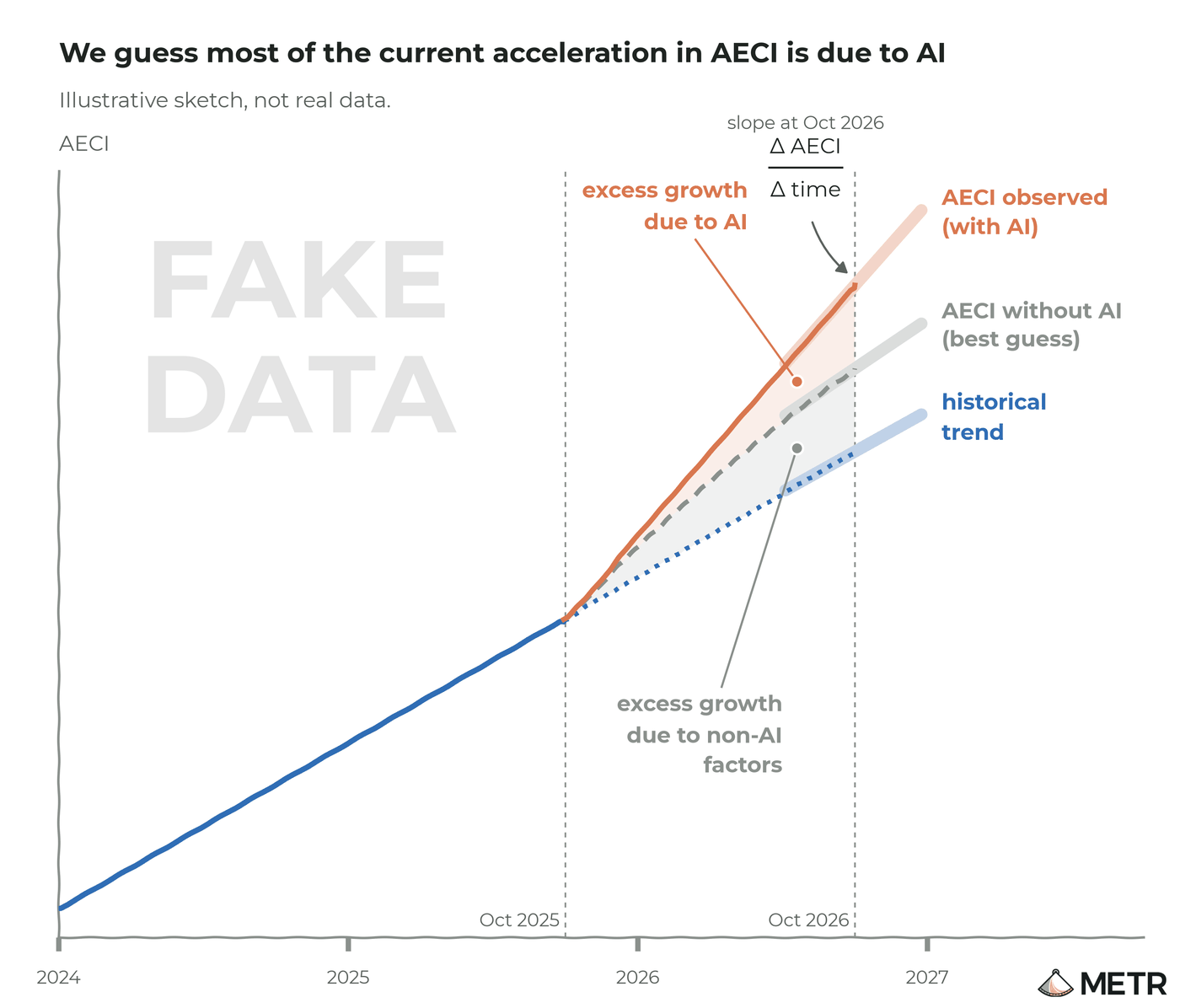
https://metr.org/assets/images/ai-rd-acceleration-assessment...
[–] atemerev 1 day ago
[–] enraged_camel 1 day ago
[–] amelius 1 day ago
[–] 12dk-as 1 day ago
Mathematicians for example have used it as cope for their current reliance on unsavory corporations, telling themselves "just one more year, and I can solve a millennium problem on my Asus Strix".
[–] origini 1 day ago
Im not telling it what to do, i ask it for ar eport/analysis and research and read its article and tell it what to implement based on 'feelings' and it works.
Limit is hardware and tokens and an AI Researcher not having hardware or tokens is probably not what they refer to.
Alone normal researchers were quite handicaped: converting data from tool a to python library x, understanding how tools work, doing basic google research etc.
[–] 0x20cowboy 1 day ago
On a more fun note, I also find just trying some hair brained idea is now extremely cheap - so why not? I used to have to weigh up spending a week of effort on something likely not to work and now I can now get spit out test in 20 minutes.
[–] XenophileJKO 1 day ago
The agent then works for 20 minutes and comes back with, "Yes this is a problem. Here is the evidence. Here is a golden data set. Finally I built a new evaluation metric and benchmark where we can back test or use for new model experiments to see if we are closing the gap."
[–] gwbas1c 1 day ago
I read it about 20 years ago, and once it got into nanobots and Kurzweil's vision that the whole universe would be intelligent, I didn't find the book credible.
But I'm wondering if the short-term prediction, that in the 2030s we won't be able to anticipate what tech does for us, (IE, the Singularity,) is useful?
[–] tim333 14 hours ago
The "whole universe would be intelligent" bit I think is quite plausible in the long term. You need robots that can build robots and for them to be able to mine asteroids and build factories in space and then it's all go. I'm not sure it's that far off. A decade or two maybe?
>in the 2030s we won't be able to anticipate what tech does for us
His prediction was 2029 for the Turing test which I think was a bit conservative - I think 2025? He said 2045 for the singularity which was roughly when things are weird enough to be hard to predict.
[–] senordevnyc 1 day ago
Even if he turns out to be a decade or two off, that’s basically exactly correct in the sweep of history sense.
Wild time to be alive.
[–] davidclark 1 day ago
Then their reasons should not be believed.
[–] megadragon9 1 day ago
[–] randomNumber7 1 day ago
On the other hand I still only get meaningless blabla when I let them write s.th. without telling what is important.
[–] asdfman123 1 day ago
[–] ilaksh 1 day ago
I suspect that part of the reason some people are hoping for that to happen is that they thoroughly mix up AGI and ASI. We do not need some kind of omnipotent god-like super intelligence in order to get much greater than human level capabilities. We are actually almost there in a lot of ways. In some aspects like speed and breadth of knowledge, very superhuman.
What I think is going to happen is that within a few years, maybe 18 months to 5 years, the new materials and compute-in-memory research is going to land in data centers at scale.
That is going to be 10-50+ larger models, 10-50+ faster, much smarter than humans. 50+ less electricity usage.
At some point, it is going to be obvious to people that if we want to maintain control of planet earth then we need to maintain control of AI research to some degree.
Assuming that superintelligence will be benevolent and just.. going for it to me is something that might earn the human species a Darwin award.
[–] inshard 1 day ago
[–] lifeisloving 1 day ago
These people are literally just a public relations operation for the big AI labs. I equate them more with a lobbying firm than I do a research firm.
[–] azan_ 1 day ago
[–] lifeisloving 1 day ago
Please enlighten me. Most of them are cognitive scientists, who are mentally ill with little understanding of computers, larping as if they do. Its a chapter of the effective altruistic cult.
They are lobbyists at best, and a psychological operations unit of effective altruistic AI syndicate at worse. There's no real science being done, it's a bunch of moonlighting philosophers yapping and getting paid by labs to scare the normies and polticians by getting their "research" quoted in the NYT.
[–] 47484885 19 hours ago
Once the gravy train ends they are not grooming any more OF girls off reddit
[–] ionwake 1 day ago
Could be from a sandwich that tastes like the best sandwich ever, but is super bad for your cholesterol or something.
I dont know where Im going with this.
Actually did some research I think the term is "Wireheading" from a story/theory from the 50s
[–] arthurbrown 1 day ago
[–] michaelhoney 1 day ago
[–] senderista 1 day ago
[–] mlmonkey 1 day ago
In my own work, I've found that it's much faster to brainstorm with a frontier model like Opus. I'll have an idea and be able to get a working implementation and try it out on toy problems within O(minutes), instead of O(weeks) earlier.
[–] usernametaken29 1 day ago
[–] porridgeraisin 1 day ago
A lot of great papers by great people had a lot of AI involved and accelerating it of course, but the majority is meaningless (sometimes autoresearch) slop.
Specifically talking about recent neurips/iclr.
[–] bee_rider 1 day ago
[–] spwa4 1 day ago
Therefore it cannot avoid taxes the way they did before (using shell companies to route the money through tax havens). It'll be expensive, every government will double the price or more, and you're selling to consumers, and the products will be at the mercy of every government where they try to sell AI and other services.
People don't get how serious this is. If AI doubles revenue but drives silicon valley firms' tax rates from 5% to 10%, it's a loss.
Add to that that it's something silicon valley firms have never done before.
[–] kennywinker 1 day ago
Would you rather make $1,000,000 and pay $50,000 in taxes, or make $2,000,000 and pay $200,000 in taxes?
Unless you’re terrible at math, i feel like i’m missing something ;)
[–] usernametaken29 1 day ago
[–] LogicFailsMe 17 hours ago
But also, you could give civilization a bad day without it if some geopolitical auteur put a half-assed WOPR frontier model in charge of a nuclear arsenal.
But oh the pushback for not believing in a near-term robot apocalypse. Why is that?
[–] strongwaddle 1 day ago
[–] Murfalo 19 hours ago
Really all it shows is 2025-26 saw a bit more improvement than 2024-25, but nowhere near "dramatic" and NOT "accelerating".
[–] bigbuppo 23 hours ago
[–] andai 18 hours ago
[–] madsgarff 21 hours ago
[–] conartist6 1 day ago
[–] brink 1 day ago
[–] marcosdumay 1 day ago
[–] conartist6 1 day ago
[–] kennywinker 1 day ago
[–] yewenjie 1 day ago
The only question that you have to ask yourself is:
Is coming up with more efficient AI architecture really much more difficult than solving millennium prize problems?
Before you jump to type out that one has verifiable rewards, is more structured and the other requires real creative thinking, just remember that the same argument has been said about the millennium problems, and about every other goalpost.
[–] 47484885 19 hours ago
[–] yewenjie 16 hours ago
[–] suddenlybananas 21 hours ago
Who knows!
[–] tsunamifury 1 day ago
[–] atemerev 1 day ago
AIs do not kill people, people kill people.
[–] intenex 1 day ago
A simple thought experiment - imagine AI discovers a way to make nuclear bombs capable of destroying the entire world radically more cheaply and accessibly with common items anyone can purchase. AI can help anyone build these nukes trivially. Even if the AI and the nukes don’t kill people on their own, do you want literally every human on earth to have this power in their pocket? Do you think it would be a net positive outcome for us vs a world where that’s not the case?
[–] Paradigma11 16 hours ago
[–] atemerev 18 hours ago
[–] metalman 20 hours ago
[–] binbag 1 day ago
> we would reach extreme superintelligence within a year
What does infinite capabilities mean? How about putting the growth on a log scale and see how that curve might look?
What the hell is extreme superintelligence?
[–] rtrgrd 1 day ago
Since the sequence 6+3+1.5+0.75+... never actually reaches 12 (geometric series), within a year they capabilities would have already been 'doubled' infinitely many times.
Obviously this argument relies on a ton of spherical cow assumptions (and the author does acknowledge this), but i think there overall point is correct that this form of growth (where time horizons compress) is _even faster_ than exponential growth.
[–] mapontosevenths 1 day ago
That is factually incorrect, and seems to be much of the premise behind the authors way of thinking.
EDIT - No it doesn't. I replied to the wrong post. Mea Culpa.
[–] hobom 1 day ago
[–] mapontosevenths 1 day ago
[–] rooftopzen 1 day ago
[–] lifeisloving 1 day ago
I dont think super intelligence will be here in a year, I think within a year AI/llms will have a similar sentiment surrounding them that NFTs do know (it already does for most normies). And most people will be recovering from a hype induced mania they lived in for two years straight.
Of course its more useful than NFTs, but when there's no giant bag to farm these hype monsters will inevitably disappear.
The bags are drying up fortunately and tokens/inference seems to be experiencing deflation, and hardware prices will eventually pop and contribute to further deflation, Then all the bag chasers will move back to crypto or whatever gets hot next.
[–] michaelhoney 1 day ago
Not everything is grift.
[–] 47484885 19 hours ago
[–] lifeisloving 1 day ago
[–] frozenseven 19 hours ago
And you people have been repeating this meaningless phrase for over six years now. But AI hasn't gone away, now has it? Progress is speeding up. Superintelligence is coming.
[–] annodomini2019 1 day ago
After the election, titles like this just irritate me. Every piece written about AI progress is:
"The machines taking jobs, flooding the internet with sludge and poisoning our online experiences, are getting better even faster! Isn't this incredible? Yeah but sorry we also think it's only riskier than ever to deploy these systems at scale. That being said, we're still going to do it, go public and take institutional money from people's retirement funds, destroy the job market, and make 3000 Anthropic employees and 500 investors really rich. There wasn't anything we could do besides write a lot of ink on it and be shocked we lost every local data center referendum."
[–] reasonableklout 1 day ago
The author of this article works for METR and not Anthropic, their whole job is supposed to be providing independent oversight on the labs. They are definitely not in the "this is incredible" crowd, they are the ones asking for development and deployment to slow down.
But that’s just the parts of ML research that take place within your compute environment, namely experiments on model architecture, training strategy, UI/UX, etc. The algorithms and software.
Just because that part of research is progressively accelerated does not imply that we’re on a collision course with world-ending “superintelligence”. It just means that you’ll get to the best possible model of your data faster. And even when your data is the entire corpus of textual knowledge, there is a limit to the utility that provides.
It just means that software engineering, data analysis, and other computational tasks will be less of a bottleneck in the overall progress of the world (which, by the way, is great, and extremely valuable).
I don’t think it’s a stretch to say that we’ll have reached max LLM capability within a couple of years (what the author refers to as “super intelligence”). But it is a huge logical leap to say this:
> If we go through this feedback loop, I expect that the AI systems that come out the other side will be able to very quickly develop novel weapons and very easily overpower human civilization in a conflict.
First of all, the weapons necessary to overpower human civilization exist. They aren’t used as such due to geopolitics and humans’ basic survival instinct. Second, developing novel weapons requires physical tests, which are decidedly not accelerated by LLMs.
AI is a tool wielded by humans. If we’re wiped out by AI, it will be at the direction of a human. But we’ve made it pretty far with some pretty unstable humans in command of planet-killer weapons. I’m not overly concerned.