[–] petcat 1 day ago
[–] aftbit 1 day ago
My experience with power outages (after big summer storms, not a hurricane thank goodness) has been that my neighborhood is impacted, but that places nearby have power. They tend to restore commercial first, so the supercharger near me is up and running before my house.
[–] sumeno 1 day ago
[–] labcomputer 1 day ago
[–] solyin 1 day ago
There are practical issues with it, but it's possible. The question is EROI or Energy Return on Investment. Do you get more energy from it than it took to make it, which unfortunately is not there yet. Shrinking it down to fit into your backyard is an exercise left for the reader.
[–] marcta 1 day ago
[–] localhost 1 day ago
[–] SJC_Hacker 1 day ago
[–] petcat 1 day ago
And that's assuming they are sunny days.
[–] lanstin 1 day ago
[–] xedrac 17 hours ago
[–] lostlogin 1 day ago
But yes, it needs to be sunny if that’s going to be pure solar.
[–] ryanbrunner 1 day ago
[–] imtringued 21 hours ago
[–] sveme 1 day ago
[–] rightnutwingjob 1 day ago
[–] its_ethan 1 day ago
[–] rightnutwingjob 1 day ago
[–] rightnutwingjob 1 day ago
[–] scarecrowbob 1 day ago
I'm 100% off grid on solar in the middle of nowhere. My panels could burn up, get hit by hail, get searched by law enforcement, flooded out, eaten by mice, stolen by miscreants, abducted by aliens or buried in snow. And of course in the event of a volcano they are probably not gonna function well.
So they are of course totally unworkable in events when the power grid is down.
But I like using them and they've been reliable so far...
[–] LordDragonfang 1 day ago
And are regularly rotating that stockpile, because gasoline has a shelf life measured in months
edit: Apparently this leans more technically-true factoid than fact, thank you replies
[–] AngryData 1 day ago
Simpler gas equipment like mowers and generators don't have enough compression to really care about anything but ancient gas, and if you run any vehicle that is multi-fuel capable it can detect and adjust compression based on a fuel's capabilities.
Ive been repairing and fixing junkers of cars, mowers, ATVs, generators, and more for 30 years and not once has bad gas stopped something from running. I only remove it if it was clearly having water raining into the tank. In every other case where I couldn't start something after sitting around for 5+ years, it was from the gas gumming up in the carb or the shitty diaphragm pump, which generally means there is little to no gas left to start with.
I wouldn't even suspect gas of ever being bad unless it was atleast a few years old. If the tank was open it could have evaporated, if the tank was closed it probably ain't great gas but I bet it would still run in anything but a high compression application.
[–] dotancohen 1 day ago
Spark, not compression.
[–] JshWright 15 hours ago
[–] dotancohen 2 hours ago
The term was always called spark adjustment, never compression. Compression is the thing you worry about when milling the heads or exchanging oscillating components (rods, pistons) due to changing the physical geometry of the combustion chamber.
So yes, adjusting the spark timing does technically adjust how compressed the air/fuel mixture is at the moment of ignition. But the term used to describe it has always been "adjusting spark" or "adjusting spark timing" or "adjusting timing". Nobody ever refers to that as "adjusting compression" because the term compression is used to refer to something else.
[–] Ariarule 1 day ago
[–] ljf 1 day ago
[–] ssl-3 1 day ago
That was surprising to me because it was working quite well when parked, and I'm used to doing things like leaving lawnmowers outside continuously (including over the winter) without much trouble, but that's what happened anyway.
I drained the old fuel out and replaced with fresh, and it fired up on the first subsequent half-assed pull of the starter rope.
(Which reminds me: It's been six months again already. Time to see if it still works.)
[–] mgerdts 1 day ago
[–] greenavocado 1 day ago
[–] bloomingeek 14 hours ago
[–] ryanbrunner 1 day ago
[–] lostlogin 1 day ago
[–] bloomingeek 14 hours ago
[–] ssl-3 11 hours ago
Somewhat simplified: As long as the feedback loop demands an injector duty cycle that is within predetermined limits, it can compensate for and run reasonably well on gas that burns relatively poorly (for whatever reason it does) by simply sending more fuel into the holes.
Conditions that produce pinging are further sought to be thwarted by using a knock sensor for additional feedback.
A Corolla has a lot of stuff going for it that can help deal with fuel variations and issues in ways that a majority of small engines are completely incapable of.
It tends to resolve to: Climb in, turn key, engine starts easily, and car drives fine -- just like it has done thousands of times before.
[–] xattt 1 day ago
I am guessing that one of the use cases is a support unit to charge an EV just enough to get it to a charging station.
[–] jethro_tell 1 day ago
edit: I think these also had a ford branded chainsaw over the wheel well on the other side of the engine bay.
[–] jcomp 1 day ago
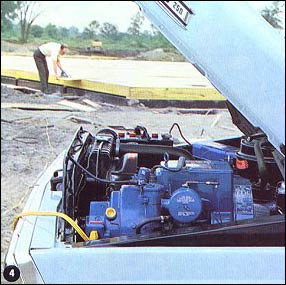
"The generator was called the Electric Power Pak. From 1969 to 1972, Ford offered a 2,500-watt underhood generator, mostly on the Contractor’s Special, though it could be special ordered on other trucks. It also wasn’t driven off the engine’s belt. It was a separate Onan generator with its own 5.5 hp air-cooled single-cylinder engine, feeding an outlet in the bed. It sat on the driver’s side splash pan. The package the commenter calls a “Rancher” is likely the Farm & Ranch Special, which is one of the trucks that came with it.
The chainsaw was real. Ford sold Ford-blue chainsaws from 1970 to about 1976. They were rebadged Ohlsson & Rice saws: the Eagle I/II and the smaller Hawk. A mount was also sold that held the saw on the F-250’s driver’s side inner fender"
https://www.fordification.com/tech/images/onan_brochure-phot... https://images.squarespace-cdn.com/content/v1/5601f99be4b059... https://www.fordification.com/tech/onan.htm

[–] jethro_tell 1 day ago
[–] ssl-3 1 day ago
As an electrical generator, it's really not very good. The alternator is rated at 120 Amps (bigger than many, smaller than others).
At 13.8v, that's only 1,656 Watts -- on a good day, with the engine wound up. But the engine won't be wound up. It will instead be idling. The output will be less than 1656 Watts.
It burns right around 0.6 gallons of gasoline per hour (ie 22kW!) while idling and doing ~nothing else. It holds 21 gallons of gas.
So the unachievable best-case of idling-and-doing-no-real-work means that if it starts with a full tank of fuel, it will run out in 35 hours.
And in the real world, it will be doing work since that's the whole point of the exercise. It will therefore use somewhat more than its do-nothing 0.6 gallons per hour idle consumption.
We can ignore the longevity issues of treating a gas-fired vehicle as a stationary generator (these are expensive parts that are getting abnormally heat-soaked) because this is a temporary solution to a temporary problem, but as a practical matter: I'll still need to fill it up with gas, however I do that[1], about every day.
And, sure: That can be a way to solve some problems. With a decent inverter stashed out of the weather, connected with appropriately-big cables, I can probably use it to run the gas-fired furnace, the fridge and freezer, some lights, and some digital entertainment. Maybe it can't run all of that at the same time, but I'm smart and I'll manage.
The gas-fired car probably is useful, as long as I can drive somewhere and fill it back up.
---
Or: I could just plug stuff into an appropriate EV. It can sit there quietly being the giant battery that it is, and I can drive it out every couple/three days, or maybe just once per week as some suggest, to fill it back up.
It won't have an idle baseload of anywhere near the equivalent of 0.6 gallons of gasoline and it will therefore respond well to intermittent, dynamic loads like heat and refrigeration.
The EV is probably more-useful, as long as I can drive somewhere and charge it back up.
---
[1]: Sure, sure. I can carry a large quantity of gasoline to make the trips more-worthwhile. I can even store some locally (it's a pain to keep it fresh, but do-able).
If I were into that kind of prepping then what would be my practical limit? An extra 40 gallons, for ~60 overall? Great! Now I can run the car/house combo for 3 days before heading back out, and the EV still probably wins on this metric.
[–] dj_gitmo 7 hours ago
[–] ssl-3 5 hours ago
That'd be a great option to explore!
Regular cars are very inefficient at the job. Mine maths out to somewhere around 7% efficiency from fuel-to-electrical-power (and without yet involving the necessary inverter).
But for generating electrical power, PHEVs have very different tricks than a typical-and-pedestrian sleepy belt-driven alternator has.
Any pointers on a candidate model, or range of models, that include this function as a built-in intent?
---
I was tempted to get into the maths of using a regular gas-fired car intermittently to charge batteries. Maybe with something like an Anker Solix that has enough surge capacity to start a normal-ish furnace blower or fridge compressor, and can accept ~800W of power from a running car's 12v system for charging and/or output.
The temptation persists to write further about that kind of concept at some point, but the previous comment was getting long-enough that people tend to tune out anyway.
---
Except, as an aside: After the 2012 derecho where my neighborhood was without power for a couple of weeks, a neighbor down the block from me parked a minty-looking John Deere tractor in his driveway. This was connected, via PTO, to a rather beefy generator.
That combination (a tractor with a PTO is meant to do stationary-engine duty while doing significant work) sure did look expensive to keep going.
But it was still humming along every time I went past, so it must have been working for him.
(And during that outage, the big corpo gas station just a few blocks further out grew a genset the size of a shipping container that powered their operation. After they got that going, which took a couple of days from the start of the blackout, they were running very normally. IIRC it took them more days to get it disconnected and shut down than to get it delivered and set up, but it worked, and we all had fuel nearby.)
It has other downsides, obviously. But the notion of "emergency power for your house" isn't really anything special.